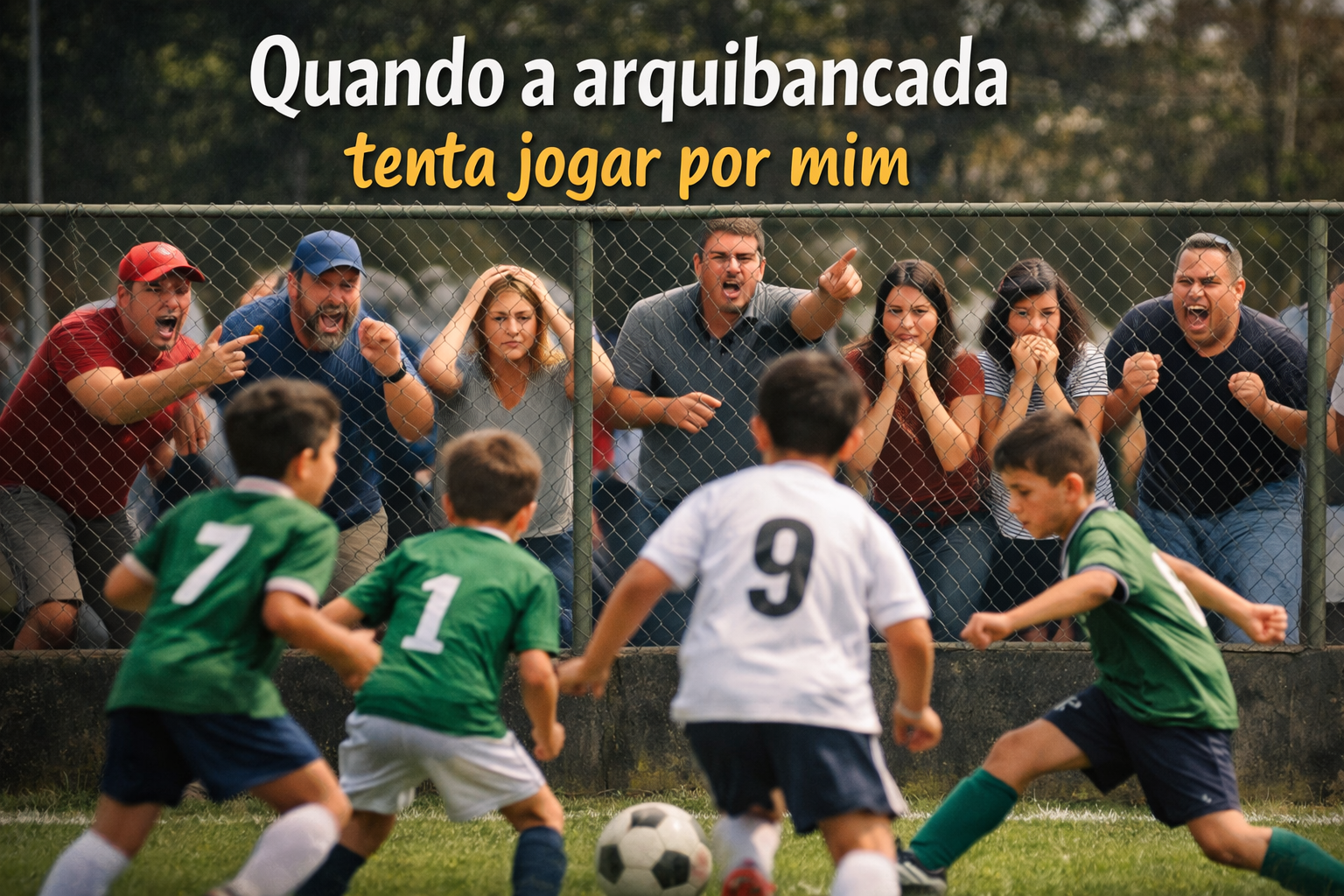
O campo é o seu lugar.
É ali que você corre, tenta, erra, aprende, sonha.
A arquibancada é o lugar da torcida.
É onde moram os aplausos, os sorrisos, os olhos cheios de orgulho.
Mas às vezes… alguns torcedores se esquecem disso.
Eles passam a agir como se estivessem dentro do jogo.
As palmas viram ordens.
Os gritos viram comandos.
E aquilo que deveria ficar guardado dentro do adulto escapa pela boca.
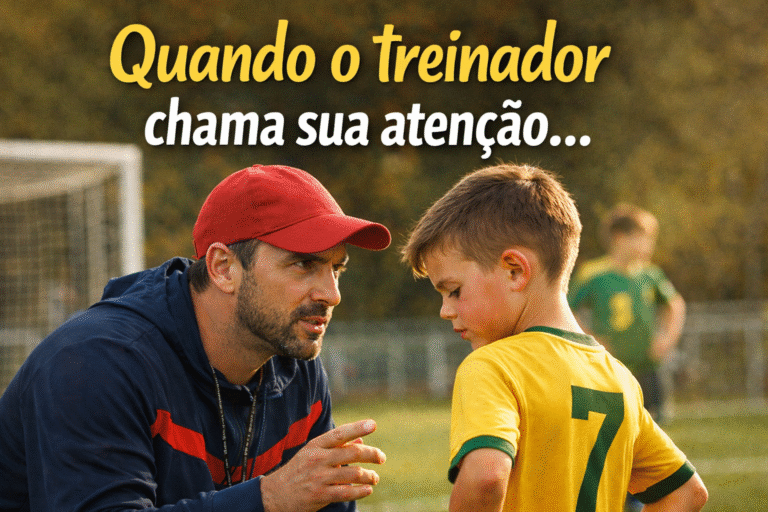
Essas vozes se misturam com as orientações do treinador.
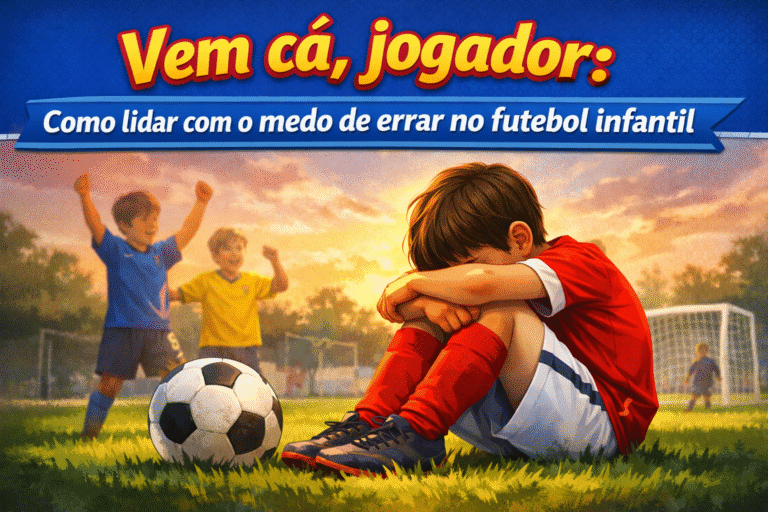
E dentro da sua cabeça acontece um nó.
São vozes importantes. Vozes que você ama.
Por isso tocam tão fundo no seu coração.
Mas, durante o jogo, elas deveriam soar apenas para elogiar, encorajar, proteger.
Quando o treinador pede uma coisa e alguém da família grita outra,
o coração acelera,
a perna trava,
a cabeça confunde.
Aqui a gente vai conversar sobre algo muito importante
como proteger o seu brilho dentro de campo
e aprender a filtrar o que seus ouvidos escutam.
Este conteúdo também está disponível em inglês ao final da página, para famílias que acompanham o futebol infantil fora do Brasil.
O barulho da arquibancada na minha cabeça
Quando a arquibancada tenta jogar por mim, a minha mente fica sem norte.
É como quando muitos adultos tentam mandar ao mesmo tempo.
Dentro do campo, eu posso sentir:
Confusão
“Se eu ouvir meu pai, o professor briga. Se eu ouvir o professor, meu pai fica triste.”
Pressão
O medo de errar fica maior que a vontade de tentar algo novo.
Tristeza
Às vezes, um grito dói mais do que cair no gramado.
E isso não é frescura.
Isso é sentimento.
Aqui, quem fala sou eu, a autora, que vive o futebol infantil de perto.
Eu vejo muitas crianças ficarem tristes, fechadas ou irritadas quando o barulho é intenso.
Vejo pais orientando seus filhos o tempo todo.
Vejo adultos dizendo o que o filho do outro deveria fazer.
Vejo palavras duras, constrangimentos, xingamentos ao juiz.
Vejo a torcida adversária desrespeitando crianças pequenas.
Tudo isso chega no coração de quem ainda está aprendendo a ser grande.
Cada um tem o seu papel no futebol infantil
Para um time funcionar, cada um tem seu papel.
Pense numa banda.
Se todo mundo tocar uma música diferente, vira bagunça.
O treinador é como o maestro.
Ele estuda, planeja e sabe o que você precisa aprender agora.
Os pais são o combustível.
Eles existem para torcer, abraçar, cuidar, levar água, sorrir depois do jogo.
Dentro do campo, quem te orienta é o treinador
Fora dele, quem te fortalece são seus pais.
Se cada um exercer somente o seu papel a criança fica mais protegida, fica mais segura.
Quando esses papéis se misturam, o jogo fica pesado para quem ainda está crescendo.
A minha bolha de proteção dentro do campo
Quando você entrar em campo, crie uma bolha invisível.
Dentro dela só entram:
- o apito
- a bola
- a voz do seu treinador
- e o seu próprio coração
O resto vira barulho de fundo.
Você pode aprender a filtrar o que ouve.
Dê atenção às orientações do seu treinador.
Escute seus companheiros de equipe.
E deixe que os gritos que não ajudam passem como vento.
Você não precisa obedecer comandos que não vêm de quem está dentro do jogo com você.
Este conteúdo também está disponível em inglês ao final da página, para famílias que acompanham o futebol infantil fora do Brasil.
Sobre errar, perder e continuar
Alguns adultos acreditam que, se não falarem, a criança não vai render.
Esquecem que o crescimento acontece naturalmente.
Errar é parte do caminho.
Perder também.
Nós não crescemos apenas quando agradamos e ganhamos.
Crescemos muito quando perdemos tambem.
Os valores são diferentes, mas os aprendizados são igualmente valiosos.
O jogo ensina em todas as situações.
Mas só ensina de verdade quando a criança se sente segura.
Aqui no Pequeno Atleta, a gente sempre lembra que a criança vem antes do atleta.
Se você quer aprofundar esse olhar, leia A Criança Antes do Atleta.
O que eu posso pedir aos meus pais
Se algo te machuca, você pode falar com carinho.
Num momento calmo, diga algo simples:
“Pai, mãe, eu amo que vocês venham me ver.
Mas quando vocês gritam instruções, eu fico confuso e não consigo jogar bem.
Vocês podem só torcer por mim?”
Você também pode pedir:
“Quando vocês falam comigo alto, eu fico com vergonha.”
“Quando falam com meus colegas, eles ficam tristes.”
“Eu jogo melhor quando escuto só o meu treinador.”
Falar com respeito também é um jeito de ser forte.
Um recado para quem torce por mim
Seus filhos crescem rápido.
Em pouco tempo, muitos de vocês não poderão mais assistir aos treinos.
O campo deixará de ser um lugar tão aberto.
E esse tempo de agora não volta.
Não gastem essa fase preciosa com tensão.
Gastem com orgulho.
Com elogios.
Com presença leve.
O jogo não é de vocês.
É deles.
O barulho que constrói é o que valoriza.
O que machuca atrapalha.
Seu filho não precisa de um técnico na arquibancada.
Ele precisa de um porto seguro.
Este conteúdo também está disponível em inglês ao final da página, para famílias que acompanham o futebol infantil fora do Brasil.
Um recado para quem me ensina
Vocês têm um papel essencial.
Peçam ajuda à arquibancada.
Protejam o ambiente do jogo.
Expliquem que o excesso de barulho impede que as crianças ouçam vocês.
Educar pais também é formar atletas.
Quando o adulto aprende, a criança floresce.
O campo é o lugar da criança.
A arquibancada é o lugar do amor.
Quando cada um ocupa o seu espaço,
o jogo vira aprendizado,
o erro vira caminho,
e o esporte volta a ser o que sempre deveria ser
um lugar de alegria.
The Field Is Your Place
The field is your place.
It’s where you run, try, make mistakes, learn, and dream.
The stands are the place for cheering.
That’s where applause lives.
Smiles.
Proud eyes watching.
But sometimes… some supporters forget that.
They start acting like they are inside the game.
Applause turns into orders.
Shouts turn into commands.
And what should stay inside the adult spills out of their mouth.
Those voices mix with the coach’s instructions.
And inside your head, everything gets tangled.
They are important voices.
Voices you love.
That’s why they touch your heart so deeply.
But during the game, those voices should sound only to praise, encourage, and protect.
When the coach asks for one thing and a family member shouts another,
your heart races,
your legs freeze,
your mind gets confused.
Here, we are going to talk about something very important:
how to protect your shine on the field
and how to learn to filter what your ears hear.
The noise that lives inside my head
When the stands try to play the game for me, my mind loses direction.
It’s like when too many adults try to give orders at the same time.
On the field, I might feel:
Confusion
“If I listen to my dad, the coach gets upset.
If I listen to the coach, my dad gets sad.”
Pressure
The fear of making mistakes becomes stronger than the desire to try something new.
Sadness
Sometimes a shout hurts more than falling on the grass.
And this is not being dramatic.
This is emotion.
Here, I speak as the author, someone who lives youth soccer closely.
I see many children becoming sad, closed off, or irritated when the noise is too loud.
I see parents instructing their children all the time.
I see adults telling other people’s children what they should do.
I see harsh words, embarrassment, yelling at referees.
I see opposing fans disrespecting young children.
All of this reaches the hearts of those who are still learning how to grow.
Who does what in the game
For a team to work, everyone has a role.
Think of a band.
If everyone plays a different song, it becomes chaos.
The coach is like the conductor.
They study, plan, and know what you need to learn right now.
Parents are the fuel.
They are there to cheer, hug, care, bring water, and smile after the game.
On the field, the coach guides you.
Off the field, your parents strengthen you.
When these roles mix, the game becomes heavy for those who are still growing.
My protective bubble on the field
When you step onto the field, create an invisible bubble.
Inside it, only these things enter:
the whistle,
the ball,
your coach’s voice,
and your own heart.
Everything else becomes background noise.
You can learn to filter what you hear.
Pay attention to your coach’s instructions.
Listen to your teammates.
Let the shouts that don’t help pass like the wind.
You don’t have to obey commands that don’t come from those who are in the game with you.
About making mistakes, losing, and continuing
Some adults believe that if they don’t shout, the child won’t perform.
They forget that growth happens naturally.
Making mistakes is part of the journey.
Losing too.
We don’t grow only when we please others and win.
We grow a lot when we lose as well.
The lessons are different,
but they are just as valuable.
The game teaches in every situation.
But it only truly teaches when the child feels safe.
Here at Pequeno Atleta, we always remember:
the child comes before the athlete.
If you want to go deeper into this perspective, read The Child Before the Athlete.
What I can ask my parents
If something hurts you, you can speak with kindness.
In a calm moment, say something simple:
“Mom, Dad, I love that you come to watch me play.
But when you shout instructions, I get confused and can’t play well.
Can you just cheer for me?”
You can also say:
“When you talk loudly to me, I feel embarrassed.”
“When you talk to my teammates, they feel sad.”
“I play better when I only listen to my coach.”
Speaking with respect is also a way to be strong.
A message to those who cheer for me
Your children grow fast.
Soon, many of you won’t be able to watch practices anymore.
The field will no longer be such an open place.
And this time will not come back.
Don’t spend this precious phase with tension.
Spend it with pride.
With encouragement.
With light presence.
The game is not yours.
It’s theirs.
The noise that builds is the one that values.
The noise that hurts only gets in the way.
Your child doesn’t need another coach in the stands.
They need a safe harbor.
A message to those who teach me
You have an essential role.
Ask for help from the stands.
Protect the game environment.
Explain that too much noise makes it hard for children to hear you.
Educating parents is also developing athletes.
When adults learn, children flourish.
The field is the child’s place.
The stands are the place of love.
When everyone stays in their space,
the game becomes learning,
mistakes become pathways,
and sport returns to what it should always be:
a place of joy.