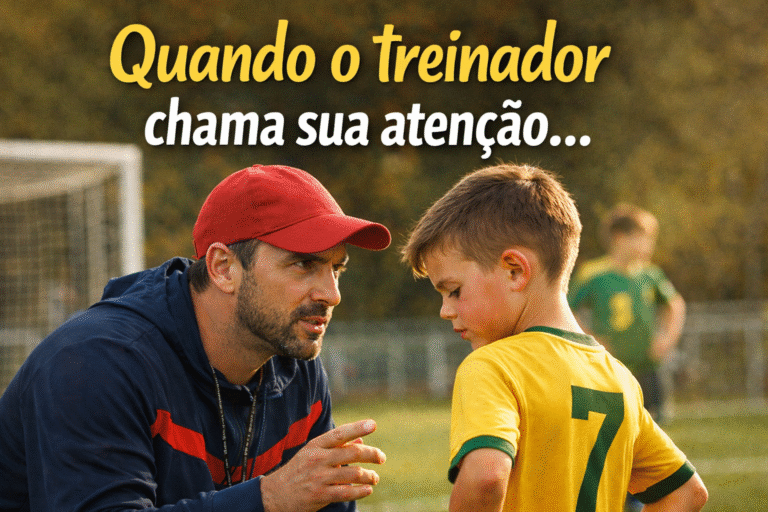
Você sente um apertinho no peito quando o outro jogador brilha mais que você?
Vem cá, jogador.
Chega mais perto.
Hoje não foi você.
Tem dias em que o jogo não te escolhe.
E faz parte.
Você corre, tenta, se entrega.
Mas não saiu como você queria.
O gol não foi seu.
O passe mais bonito não saiu do seu pé.
Você estava em campo.
Tentando.
Jogando.
Mas não conseguiu entregar tudo o que sentia que podia ao jogo.
E você reparou que era o dia do colega de equipe.
Ele estava inspirado.
O nome dele era exaltado.
Era para ele que todos olhavam.
E isso doeu.
Tá tudo bem.
A vida é assim mesmo.
Existe brilho para todos.
Só que nem sempre no mesmo dia.
Este conteúdo também está disponível em inglês ao final da página, para famílias que acompanham o futebol infantil fora do Brasil.
O sentimento que aparece e quase ninguém fala
Esse sentimento aparece em muitas crianças.
Sentir-se triste por não estar conseguindo dar tudo que sente que pode no jogo é esperado.
Você tenta disfarçar.
Mas a cabeça começa a falar:
“por que não eu?”
“o que ele tem que eu não tenho?”
“será que eu fiquei para trás?”
Às vezes vem raiva.
Às vezes vem desânimo.
Às vezes vem vontade de sumir do jogo por alguns minutos.
O problema não é sentir isso
Sentir vontade de ser visto é aceitável.
O problema é o que você faz com esse sentimento.
Se isso já aconteceu com você, presta atenção:
isso não te faz fraco.
Isso te faz humano.
O perigo começa quando a comparação manda em você
O problema não é perceber que o outro está melhor hoje.
O problema é quando você começa a brigar por dentro, quando o outro jogador brilha mais que você.
Quando a comparação vira raiva, o jogo muda.
Você prende a bola.
Força jogada.
Para de jogar simples.
E, sem perceber, começa a jogar contra você mesmo.
Quando você briga por dentro, o jogo fica pesado por fora.
Sentir-se triste por não estar conseguindo dar tudo que sente que pode no jogo é esperado.
Não pode é deixar esse sentimento pelo bom desempenho do outro fazer morada em você.
Admirar o que o outro traz aos nossos olhos é um exercício importante no esporte.
Admirar o outro atleta não é se diminuir
Aqui tem algo importante que poucos aprendem cedo.
Respeitar quem está bem não te coloca abaixo.
Todo jogador tem dias de destaque.
E dias comuns.
E dias difíceis.
Esse contexto te deixa mais maduro.
Admirar o outro atleta não é perder espaço.
Não é aceitar menos.
Não é baixar a cabeça.
Admirar é reconhecer que o outro está vivendo um bom momento, ou uma boa fase, ou até mesmo um bom dia.
E entender que o futebol é feito de altos e baixos no desempenho do atleta.
Hoje foi ele.
Outro dia pode ser você.
O jogador que cresce aprende a olhar sem inveja.
E a aprender com quem está bem.
O que dá para aprender quando o outro está brilhando
Em vez de se comparar,
ou de deixar doer por dentro,
você pode observar quando o outro está brilhando:
Como ele se movimenta.
Como pede a bola.
Como decide rápido.
Como se posiciona sem a bola.
Isso não é copiar.
É aprender.
Quem aprende com o jogo cresce mais rápido do que quem só reclama dele.
Este conteúdo também está disponível em inglês ao final da página, para famílias que acompanham o futebol infantil fora do Brasil.
Seu jogo não some porque o outro apareceu
O brilho do outro não apaga o seu.
Ele não rouba sua história.
Não diminui seu valor.
O futebol não é uma corrida de um jogo só.
É um caminho longo.
Quem permanece inteiro no caminho chega mais longe.
Quem aprende a dominar suas emoções, a reagir melhor a esse momento, melhora como atleta.
O que fazer quando isso acontece com você
Quando sentir esse aperto, faça assim:
Respire fundo.
Lembre que o jogo continua.
Escolha jogar simples.
Ajude o time.
Siga presente.
Você não precisa provar nada naquele minuto.
Precisa continuar jogando.
Precisa refletir naquilo que pode melhorar, evoluindo dia a dia.
Quem continua cresce.
Um pensamento para guardar
Em vez de pensar
“ele é melhor do que eu”
experimente pensar
“hoje é o dia dele, e eu faço parte desse jogo”.
Esse pensamento te protege.
E te mantém no jogo por dentro.
Para guardar
Vem cá, jogador.
O brilho do outro não apaga o seu.
O jogo é longo.
E quem aprende a admirar sem se perder
cresce mais forte
e fica mais tempo.
O jogo continua.
E você também.
Se você é adulto e quer aprender a ajudar seu atleta a reagir melhor a este e a outros sentimentos que surgem no esporte, este material é para você!
E-book: A Criança Antes do Atleta
When Another Player Shines More Than You
Do you feel a tightness in your chest when another player shines more than you?
Come here, player.
Come a little closer.
Today wasn’t your day.
There are days when the game doesn’t choose you.
And that’s part of it.
You run, you try, you give yourself fully.
But it didn’t come out the way you wanted.
The goal wasn’t yours.
The most beautiful pass didn’t come from your foot.
You were on the field.
Trying.
Playing.
But you couldn’t give everything you felt you had inside.
And you noticed it was your teammate’s day.
He was inspired.
His name was being praised.
Everyone was looking at him.
And that hurt.
That’s okay.
Life is like that.
There is room for everyone to shine.
Just not always on the same day.
The feeling that appears and almost no one talks about
This feeling shows up in many children.
Feeling sad for not being able to give everything you know you have in a game is expected.
You try to hide it.
But your mind starts talking:
“Why not me?”
“What does he have that I don’t?”
“Did I fall behind?”
Sometimes it turns into anger.
Sometimes discouragement.
Sometimes the desire to disappear from the game for a few minutes.
The problem is not feeling this
Wanting to be seen is acceptable.
The problem is what you do with that feeling.
If this has happened to you, pay attention:
this does not make you weak.
It makes you human.
The danger begins when comparison takes over
The problem is not noticing that the other player is better today.
The problem starts when you begin fighting inside yourself because another player is shining more than you.
When comparison turns into anger, the game changes.
You hold the ball too much.
You force plays.
You stop playing simple.
And without noticing, you start playing against yourself.
When you fight inside, the game gets heavy on the outside.
Feeling sad because you couldn’t give everything you felt you had is normal.
What cannot happen is letting the other player’s good performance settle inside you.
Learning to admire what others bring to the game is an important exercise in sports.
Admiring another athlete does not mean diminishing yourself
Here is something few people learn early.
Respecting someone who is doing well does not put you below them.
Every player has standout days.
And average days.
And hard days.
This context makes you more mature.
Admiring another athlete is not losing space.
It is not accepting less.
It is not lowering your head.
Admiring is recognizing that the other is living a good moment, a good phase, or simply a good day.
And understanding that soccer is built on ups and downs in performance.
Today it was him.
Another day it can be you.
The player who grows learns to look without envy.
And to learn from those who are doing well.
What you can learn when someone else is shining
Instead of comparing yourself,
or letting it hurt inside,
you can observe when another player is shining:
How he moves.
How he asks for the ball.
How he makes quick decisions.
How he positions himself without the ball.
That’s not copying.
That’s learning.
Those who learn from the game grow faster than those who only complain about it.
Your game doesn’t disappear because someone else showed up
Someone else’s shine does not erase yours.
It doesn’t steal your story.
It doesn’t reduce your value.
Soccer is not a one-game race.
It’s a long path.
Those who stay whole along the way go further.
Those who learn to manage their emotions and react better to these moments improve as athletes.
What to do when this happens to you
When you feel that tightness, try this:
Take a deep breath.
Remember the game is still going.
Choose to play simple.
Help the team.
Stay present.
You don’t need to prove anything in that moment.
You need to keep playing.
You need to reflect on what you can improve, growing day by day.
Those who keep going grow.
A thought to keep
Instead of thinking
“he is better than me”
try thinking
“today is his day, and I am part of this game”.
This thought protects you.
And keeps you in the game on the inside.
To remember
Come here, player.
Someone else’s shine does not erase yours.
The game is long.
And those who learn to admire without losing themselves
grow stronger
and stay longer.
The game goes on.
And so do you.
If you are an adult and want to learn how to help your athlete deal better with these and other emotions that arise in sports, this material is for you.